

Distinctiveness in Branding Isn't About Creative Novelty
Being distinctive isn't the same as being different just to be different. That's a trap a lot of designers fall into — chasing an idea no one's seen before, treating novelty itself as the mark of good work. Distinctive doesn't mean rigid and boring, either. It means recognisable within a system. It solves one very specific, unsexy problem: how do people spot you and pick you when they're basically not paying attention?

Distinction - How do you stand out in a crowd of sameness?
The Novelty Trap
Novelty feels like progress. A weird new logo, an unexpected colour palette, a campaign that looks nothing like the one before it — these things generate internal excitement in a way that "the same blue we've used for ten years" never will. Design teams reward it. Award shows reward it. But the person scrolling past an ad, glancing at a shelf, or half-listening to a radio spot isn't evaluating creative merit. They're pattern-matching, fast and shallow, trying to figure out in a fraction of a second whether this is the brand they already have some relationship with.
Novelty for its own sake breaks that pattern match. Every time a brand reinvents its visual identity to feel "fresh," it quietly erases some of the recognition it spent years building. The audience has to relearn the signal. Most of them won't bother — they'll just fail to notice the brand at all, which is functionally worse than being ignored for being boring.
What Distinctiveness Actually Means
Distinctiveness is about owning a small set of recognisable assets and refusing to let go of them: a colour, a shape, a sound, a typeface, a mascot, a tagline cadence. Not because any one of these is inherently brilliant, but because repetition turns them into shortcuts. Tiffany's robin-egg blue, McDonald's arches, T-Mobile's magenta, the Coca-Cola script — none of these are conceptually daring. They're just consistent, over decades, across every touchpoint, until the brand no longer needs its name attached to be identified.

The easily recognisable Coca Cola script of the mark is enhanced by its consistent presentation in a red and white colour way.
This is the difference between a creative idea and a distinctive asset. A creative idea is judged on originality. A distinctive asset is judged on whether it's been repeated enough, in enough contexts, that it fires recognition before conscious thought kicks in. That's a memory-building exercise, not an artistic one.

How can you miss the McDonald’s golden arches?
Solving for Inattention
Most branding decisions get made as if the audience is studying them closely — comparing logos side by side, reading taglines, weighing colour choices. Almost none of them are. Most brand encounters happen in half a second, in someone's peripheral vision, while they're doing something else entirely: driving past a sign, scrolling a feed, scanning a shelf for the thing they always buy.
In that environment, subtlety is a liability. A design that would look elegant under close inspection can be invisible under real-world conditions. Distinctiveness is the design discipline built specifically for this constraint — it asks not "does this look good," but "can this be identified at a glance, at a distance, half-remembered, by someone who isn't trying." That's a much harder bar to clear than originality, and it's largely invisible in a portfolio review, which is part of why it gets undervalued.

Klarna: Iconic simplistic design and recognisable assets.
Distinctive vs. Different
There's a related idea worth separating out: meaningfully different versus distinctive. Being meaningfully different is a positioning question — do you offer something genuinely different from competitors, in a way that matters to the customer? That's valuable, but it's a separate axis from distinctiveness, which is a recognition question — regardless of what you offer, can people tell it's you?
A brand can be highly distinctive while being functionally similar to its competitors (most bottled water, most airlines, most banks). A brand can also be genuinely innovative in what it offers while being visually forgettable, and lose customers anyway because nobody can find or recall it at the moment of choice. The two are not substitutes. Chasing creative novelty often happens because "different" and "distinctive" get collapsed into the same goal, when they're solving unrelated problems.
Why Consistency Compounds
The mechanism behind distinctiveness is repetition over time, and that has a compounding quality that novelty can't replicate. Every year a brand keeps the same core assets, recognition gets a little more automatic, a little more resistant to competitor noise, a little cheaper to trigger. Every time those assets get overhauled for the sake of feeling current, the clock resets, and the brand pays down the accumulated recognition it had built.

Lacoste: Building brand recognition for over a century.
This doesn't mean a brand should never evolve. It means evolution should tighten a system rather than replace it — refining a mark, extending a colour into new applications, modernising a typeface while keeping its proportions legible as "the same one." The goal is to still be recognisable to someone who hasn't looked closely in five years.
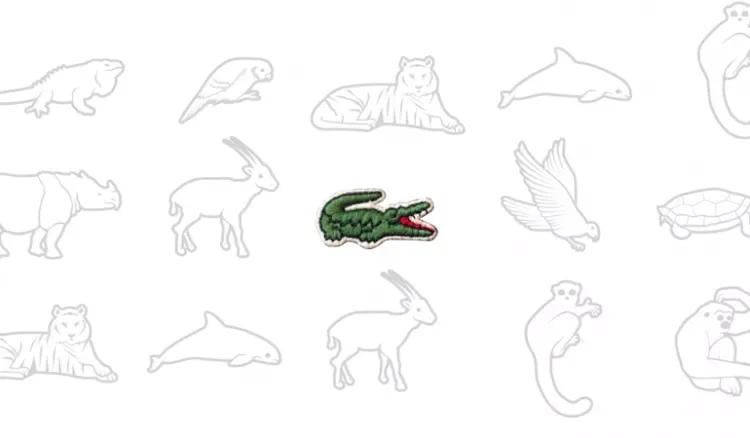
The famous Lacoste croc gets some very special, very rare company.
Credit: (Photo: Lacoste)
The Practical Takeaway
Distinctiveness is a system-level discipline, not a moment of inspired creativity. It asks designers to identify the small number of assets a brand can own, apply them with near-obsessive consistency, and resist the pull toward reinvention for its own sake. It's unglamorous work — nobody wins an award for "kept the logo the same" — but it's the work that actually gets a brand recognised by someone who is looking at a hundred other things at the same time.
The creative challenge, then, isn't to invent something no one has seen. It's to make something so consistently present that people stop needing to think about it at all.
